
 Once I went with my friends for spent some holidays on the beaches, there we had a lot of fun a coincidently it was also my birthday so they all arranged a surprise birthday party for me, we all went to the boat trips and had drinks and lots of fun there. After we all went to the clubhouse which was online and all type of gambling and betting games can play.
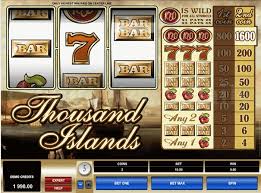
We all in a very good mood and played almost the whole night, there I played a slot machine named a thousand islands. It was three reels and single payline online casino poker machine and designed by the Microgaming. So you can play it in so many online casinos because of it from the biggest software company.
When I sign up for this amazing slot then it offered me to some free spins and I played these and took a trail with this but after these chances, I got interested in it and I bought more credits. The betting range was dollar 0.25 to dollar 5.00.
The wild and scattered symbols are the blingy rings, brandy, wristwatches, cigars and dollars icons etc. and in order to win money, you will have to match the three symbols to get a big prize or real money in your account. But when you play on the net then you have to remember some basic tips like secure and trustworthy website where you can play with your PayPal account. I hope you will like this amazing machine when you will play and win a huge amount of money with it and if you want to know more than you can found videos related to how to win it on youtube. So I hope you will like this wonderful machine and play hard to win a big amount.
Visit the Video for more.
Dark King: Forbidden Riches Slot Review
NetEnt’s 5-reel Dark King, Forbidden Riches slot is a must-try for fans of medieval gothic tales. This slot’s design is excellent, as usual. Everything has been meticulously designed, from the mysterious background to the numerous symbols that populate the reels.
You can get several bonuses when playing Dark King and Forbidden Riches online. These bonuses include multipliers, sticky wilds, and free spins. This slot is ideal for players who want to experience higher volatility and the challenges it can offer.
These Gothic Fantasy Reels will make you feel lost in the darkness NetEnt created the online slot The Dark King: Forbidden Riches.NetEnt is a top-rated slot developer in the world. They can be found in the lobby of many casinos around the globe, and their games are made to the highest standards.
These symbols are the lowest-paying, 10 J, Q, K, and A, written in beautiful Gothic script. The Dark King and his faithful knights are the higher-paying symbols. Each knight has their unique color and set of armor. The game will allow players to see knights dressed in red, blue, orange, yellow, and green. The King himself will appear in purple.
The highest-paying symbols are the King and the Wild. The latter takes the form of a brightly colored orb. The sprinkle character of the game is a red ruby with gold.
Master this Medium/High Volatility
The Dark King: Forbidden Riches slots machine has 20 pay lines. This slot has a 96.06% RTP and medium volatility. This is a great place to begin if you are looking for slots with higher volatility than others.
Keep an eye out for high-paying wilds. NetEnt has done everything possible to find unique features for the Dark King Forbidden Riches slot online. You will first encounter the wilds and multipliers. You can win a multiplier equal to the number of wild symbols currently visible on the reels, up to a maximum of 5x.
To get 15 free spins, you must land at least three scatter symbols. A sticky wild hotspot appears on reels 2, 3, and 4. If you land a wild in the hotspot, you will receive an additional spin.
Take a new quest
The Dark King: Forbidden Riches is a stunning medieval slot machine. There are many titles in this genre you might like. These are our top picks.
Red Tiger Gaming’s Legendary Excalibur is an impressive Arthurian slot with an intriguing wild mechanic. Grab the stacked wild to get free respins and win in both directions. This simple game offers fantastic chances of winning.
Nextgen Gaming’s Kingdom’s Edge slot is an excellent choice for high-stakes battles. You will find beautiful symbols in this game and stacked wilds and win multipliers. There are 25 free spins.
Today, take on the Dark King. Try the Dark King: Forbidden Wealthes online slot if you enjoy games with a solid theme. You have a great chance of landing an incredible prize with the free spins, including sticky wilds and the wild multiplier. This beautiful game is a masterpiece by NetEnt.
You can play Dark King: Forbidden Wealthes here for free or try it now for real money at one of our favorite online casinos.